
Advice for Getting Better Lamp Life
Low Voltage Halogen fittings:
- If the light is closer than 3.5 meters to the objects being illuminated, use 20 watt lamps rather than 50 watt lamps. These will save power, reduce heat and stress on the fitting, and you will not be able to tell the difference unless the object is far away.
- With dichroic lamps (Shown in picture):
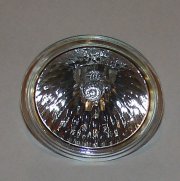
- Unless you want to highlight a small area or a specific object, always use flood (or wide angle) lamps of at least 36º or more.
- Ensure you get a sealed lamp, the front should be covered with flat glass - most dichroic lamps now days are sealed, these have better reflector life and are better in higher humidity areas.
-
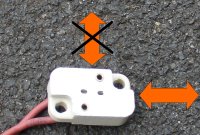
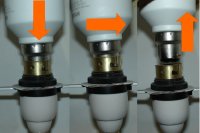
When replacing the lamps, do not force the lamp into the holder, but gently wriggle the lamp in the direction of the pins, this helps making loading the lamp easier, helps to self clean the lamp holder contacts and prevents damage to the lamp socket (See Diagram).
- Do NOT touch the glass (if so use alcohol to clean the lamp). Note: This does not apply to sealed dichroic lamps.
Linear Halogen fittings:
- Do NOT touch the glass (if so use alcohol to clean the lamp).
- The contacts should be firm, requiring a moderate force to insert the lamp.
-
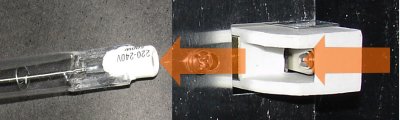
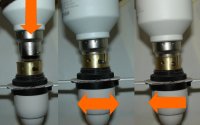
Ensure that the lamp contacts are correctly aligned and clean. To do this after inserting the lamp into the lamp holders, gently wriggle each end of the lamp, this helps to keep the lamp holder contacts clean, and also to ensure the lamp end is sitting correctly in place (see diagram, arrows indicate where lamp aligns with the lamp holder).
- Especially in sealed fittings, try to use a lower wattage lamp (usually one step down from the fittings rating) e.g. use a 300 watt lamp in the 500 watt fittings or 100 watt lamps in a 150 watt fitting etc. This will keep the fitting cooler (resulting in better lamp and fitting life) with very little drop in light output (unless lighting over a long distance, the lighting level will not be any less visually).
- Avoid using halogen lamps in areas prone to vibration (e.g. by stairs) or if outside, where the fittings may vibrate due to excessive wind.
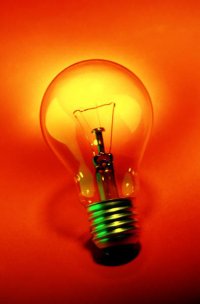
Incandescent fittings (Where the lamp uses a filament):
- LED Replacements are much more energy efficient, reliable and while more expensive are far more economical in the long term (power savings and less replacements) and pay for themselves many times over the lifetime of the LED.
- Ensure the lamp wattage is no more than the rating of the fitting. If the fitting is a standard household lamp holder, usually the shade will have a maximum rating.
- Purchase lamps from specialist lighting or electrical outlets,the lamp quality tends to be better at the specialist stores. Some manufacturers have copy cat lamps of an inferior quality but with the reputable name tag of the more genuine lamp.
-
In fittings that are used for longer periods and/or enclosed but not controlled by a dimmer, it is recommended to use energy saving LEDS or compact fluorescent lamps (CFL). These lamps will last much longer, use much less electricity, reduce heat build-up and increase the life of the fitting.
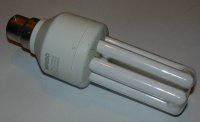
- If the fittings are subject to vibration (e.g. fittings in a lower level with people or movement in the above level etc.), use either LED or CFL lamps or rough service lamps.
- Visually inspect the lamp contacts, if the contacts are dirty then these need to be cleaned preferably by a licensed electrician or experienced person.
- If the lamp flickers after being replaced and or lamps in a particular fitting consistently has a short life span, then the lamp contacts may be loose, the lamp holder or fitting may need replaced.
- Ensure the voltage rating of the lamp is at least 240 volts (ideally 250 volt), 230 volt lamps in many areas may be slightly under rated reducing the lamp life. The higher voltage have a stronger filament and are more tolerant to voltage variances, the higher voltage lamps also tend to run at a slightly lower wattage reducing stress.
- Edison Screw Lamps - additional notes:
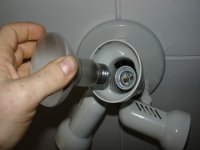
- When replacing lamps, ensure that the lamp is not "cross threaded" when it is going in, if it is difficult to turn, then remove it and try again. Do not force the lamp to turn as this may damage the lamp holder and the lamp.
- When tightening the lamp, stop once it is firm, then loosen the lamp by half a turn, repeat this step a few times. This will help keep the lamp holder contacts clean and also help prevent the lamp from sticking. If using incandescent - When the lamp is tightened for the last time, turn it back a small fraction (approx 5º anticlockwise), this will help prevent the lamp from being jammed in the lamp holder when it is to be removed.
-
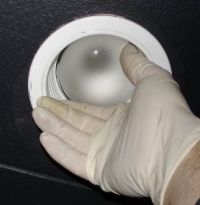
Difficult to remove lamps - Use latex rubber gloves to get a better grip on the lamp as shown.
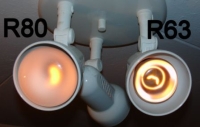
- Consider using LED, or R63 lamps rather than R80 lamps (as shown). The R63 has a slightly narrower beam but are physically smaller, making the lamp easer to install or remove, and have better cooling because of the extra space around the lamp.
- Bayonet Cap Lamps - additional notes:
- When removing the lamp, push it towards the lamp base first, before making a small anti-clockwise turn to release the lamp.
- When replacing the lamp, there should be a small to moderate amount of resistance when inserting the lamp, if not the lamp contacts may be weak. Follow the next step with caution, if you have any doubt, contact a licensed electrician. If you suspect the lamp contacts may be weak, using a non-conductive piece of material and with the power turned off to the fitting, check the spring return of each lamp contact. These should be moderately firm, and the tension on each of the two contacts should be the same. If in doubt, compare with a fitting that is new or known to be in good condition.
- If the lamp holder is showing any signs of being brittle, cracking or crumbling, then it should be replaced by a licensed electrician.
- When replacing the lamp, insert the lamp then rotate it clockwise and anticlockwise a few times before finally locking it in place. This will help keep the contact clean between the lamp holder and lamp.
Fluorescent fittings:
- In the non electronic fittings - always change the starter when changing the lamp. The starter is much cheaper than a lamp but will vastly reduce the lamp life if not operating properly. If the lamp strikes for more than 10 seconds, there is likely to be more problems with the fitting which should be repaired or replaced.
- With electronic fittings - if it is a double fitting always change both lamps, as the electrinic ballast in double fittings often is a single ballest that controls both lamps, if either lamp is not properly installed and functional, the fitting will not operate.
- Keep the lamps, fittings and diffusers clean, this will keep the light output up, the newer lamps will usually have good light output right up to the end of their life (not like to old fittings that used to reduce to 50 percent or less).
- If the tube is not going and the ends are glowing, remove the lamp and starter as soon as possible, this will save wasting power and stress on the fluorescent fitting.
-
For aesthetics match the lamp colour of the new tube with the old tube usually these are (See picture)
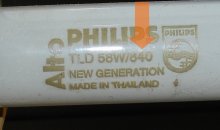
- colour 840 for offices (where a softer colour of lighting is easier on the eyes) and areas that use incandescent fittings close to the fluorescent fittings.
- 865 for workshops and display areas where a white light is more desirable.
www.energywise.govt.nz/at-home/lighting/